
Polymarket Hit by Suspected Private Key Exploit


Today in crypto, Polymarket said user funds and market resolution were safe after a suspected private key compromise tied to top-up operations led to more than $600,000 in losses, at least five high-profile companies have shuttered this week, and a petition to eliminate South Korea’s tax on crypto gains reached the threshold required for government review.
Polymarket team says user funds safe as exploit losses climb above $600,000
Polymarket confirmed a security exploit affected part of its infrastructure, pointing to a possible private key compromise involving a wallet used for top-up operations, while saying user funds and market resolution were safe.
In a Friday X post, Polymarket developers said contracts and core infrastructure were unaffected. Polymarket product lead Akanshu Jain and multiple other Polymarket employees also said user funds and market resolution are safe.
Blockchain investigator ZachXBT first flagged the exploit as a compromise to the Polymarket-linked UMA Conditional Tokens Framework (CTF) Adapter contract on Polygon, with the exploiter draining at least $520,000.
However, Josh Stevens, Polymarket’s vice president of engineering, said the contracts were safe and that the exploit was limited to a six-year-old private key used for internal top-up operations. All permissions tied to the key have been revoked, he said.
The UMA CTF adapter is an oracle contract used to help resolve Polymarket prediction markets through UMA’s Optimistic Oracle. Polymarket is the world’s second-largest prediction market with $3.7 billion in monthly trading volume, according to DefiLlama.
Polyscan data reviewed by Cointelegraph showed more than 100 small transfers into the alleged attacker wallet. Most were worth up to 5,000 Polygon (POL) tokens.
Address of the alleged Polymarket adapter contract attacker. Source: Polygonscan
Multiple blockchain data platforms reported similar onchain activity tied to the suspected exploit.
Blockchain data visualization platform Bubblemaps said in a Friday X post that the attacker continues to remove about 5,000 POL tokens every 30 seconds, amassing about $600,000 in stolen funds at the time of writing.
Five crypto firms shutter in a week amid market slump
At least five high-profile crypto companies have shuttered this week amid a prolonged downturn in the crypto market, with crypto trading card platform Fantasy.top, cross-blockchain infrastructure company Everclear, and Ethereum layer-2 blockchain ZERO Network all announcing on Thursday that they were winding down.
It comes the same week that Ethereum infrastructure firm Syndicate Labs announced it was winding down, and crypto ATM company Bitcoin Depot filed for bankruptcy in the US on Monday.
Fantasy.top said it would shut down in June as its trading volume “was not sufficient to sustainably support long-term operations.” Its co-founder, “Kipit,” said the company failed because it “tried to put crypto on top of a model that was never built for crypto,” and failed to attract people who enjoy trading card games.
Everclear said it was winding down the Everclear Foundation and Everclear Labs as it “never developed the commercial depth we needed” and couldn’t sustain meaningful revenue. Meanwhile, the ZERO Network team said it was closing down to focus on its sister crypto wallet and data service, Zerion.
The closures are the latest in a list of crypto companies that have shut this year as the industry has struggled amid a broad market downturn that has seen Bitcoin (BTC) fall about 40% from a peak of $126,000 in early October. Many public companies also reported losses in the first quarter, and the industry has laid off more than 5,000 employees this year.
Petition against South Korea’s crypto tax reaches review threshold
A formal petition to eliminate South Korea’s proposed 22% tax on digital asset investment gains has surpassed the 50,000-signature threshold required for review by the National Assembly’s Finance and Economic Planning Committee.
The tax regime is currently scheduled to take effect in January 2027. Critics argue the proposal unfairly targets the crypto industry while traditional asset classes continue to receive more favorable tax treatment.
Supporters of the petition also framed the issue as generational. Younger South Koreans, many of whom have been priced out of the housing market and other traditional paths to wealth creation, have increasingly turned to crypto investing as an alternative.
“If taxation is enforced in order to secure short-term tax revenues, it is likely to lead to greater losses in the long term, namely, a contraction of industry and an outflow of capital and talent abroad,” a translated version of the petition said.
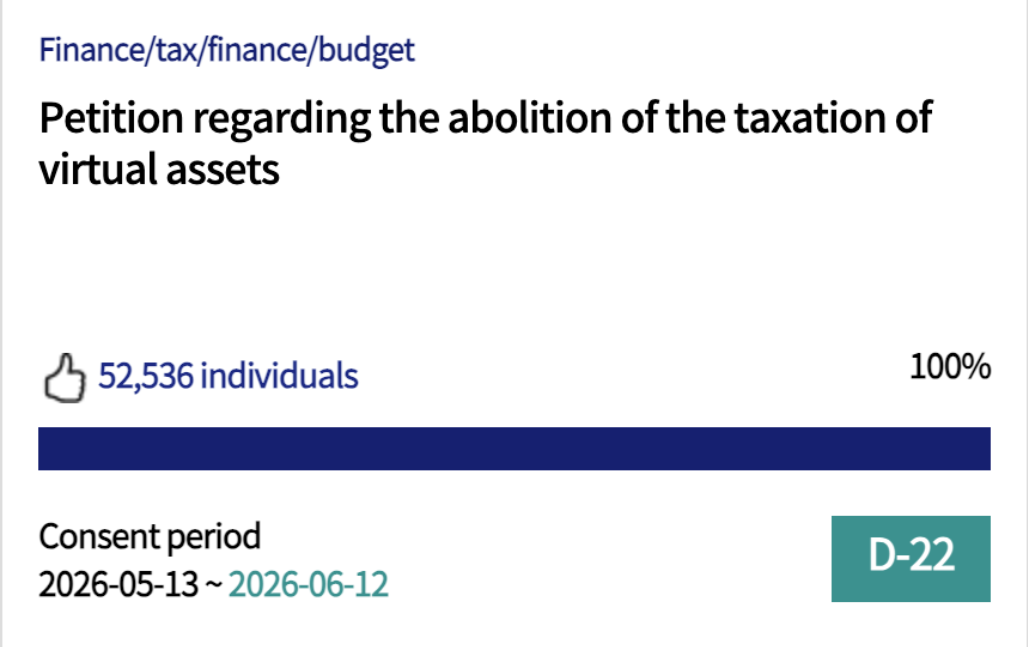
The “Petition regarding the abolition of the taxation of virtual assets” has exceeded 52,000 signatures. Source: South Korea Assembly
