
Goverment Shutdown 2026 Odds Fall as Markets Split the October 1 Risk
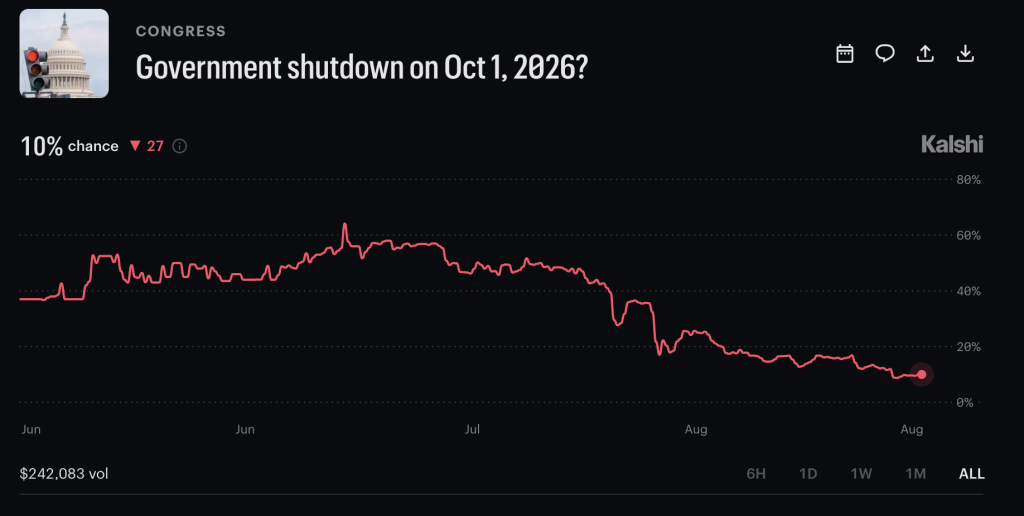

Kalshi’s contract on a federal government shutdown on October 1, 2026 priced YES at 15-16 cents, an implied odds near 10% and down sharply from 35% just three weeks earlier.
Polymarket’s parallel market, which resolves on a different trigger and a later cutoff, still showed 16.5 cents as of August 14, per Polymarket Trader’s snapshot. The gap between those two numbers says less about Washington than about how differently the two venues define a shutdown.
The Goverment Shutdown Odds In 2026 Aren’t Pricing the Same Bet
Kalshi’s contract resolves YES only if part of the government is shut down at 10:00 a.m. ET on October 1 specifically. Polymarket runs two separate contracts on the same date: one requiring an actual shutdown, agencies suspending non-excepted operations, typically with furloughs, by 11:59 p.m. ET, and a second, broader “any-duration lapse” contract that pays out even on a brief technical gap with zero operational impact.
On August 14, Polymarket priced the shutdown version at 16.5 cents and the lapse version at 13.5 cents.
A third Polymarket market bundles “another shutdown by January 31, 2027” with the 2026 House winner. Its no-shutdown legs had already settled at zero cents by the August 14 check, while the shutdown-plus-Democratic-House leg traded at 87.3 cents.
That is the market telling traders something specific: a lapse somewhere in the current funding cycle is priced as close to certain, even while an October 1 lapse specifically sits in the mid-teens.
A Five-Week Repricing, Told Through Three Snapshots
Kalshi’s own market commentary put the shutdown contract at 35% on July 31, with Senate negotiators reportedly nearing a stopgap that would fund the government to December 4 while capping a disputed OMB rule on appropriated spending.
By August 3, the cross-venue average had fallen to 28%, with Kalshi at 25% and PredictIt at 31%. Two weeks later, Kalshi had drifted down again to the 12-13% range on roughly $193,000 in contract volume.
That trajectory, 35%, then 28%, then roughly 12-13%, is a repricing toward “Congress avoids the specific date,” not toward “shutdown risk is gone.”
The combined Polymarket market’s zeroed-out no-shutdown legs for January 31 make that distinction explicit: traders are separating the October 1 deadline from the broader fiscal-year window, and pricing them very differently.
Both books remain thin relative to 2025, when related shutdown contracts on Polymarket cleared roughly $157 million in cumulative volume on the start-date market alone – a reminder that current liquidity of a few thousand to a few hundred thousand dollars leaves these prices more exposed to spread and single-trade repricing than last year’s deeper markets.
The Percentage Is Only Half the Trade. Kalshi Lets You Trade the Exact Question.
The shutdown market shows why prediction trading is more than glancing at a headline probability. A 15% contract can mean something very different from another market showing 16% if the resolution rules, timing, and trigger are not identical.
That precision is part of Kalshi’s appeal.

Users can trade directly on defined real-world outcomes across politics, economic data, Fed decisions, crypto, and other major events, with every contract spelling out exactly what must happen for YES or NO to settle.
For traders following Washington into October, that creates a cleaner way to express a view than trying to guess how stocks, bonds, Bitcoin, or the dollar might react to the same event.
The government may avoid a shutdown at 10:00 a.m. on October 1 and still face another funding crisis weeks later. Kalshi lets traders separate those questions rather than treat them as a single macro bet.
Eligible new users who join through CryptoNews can also receive $25 through our referral link.
Make Your Prediction Count With $25 For Free on Kalshi
The post Goverment Shutdown 2026 Odds Fall as Markets Split the October 1 Risk appeared first on Cryptonews.
